Editorial scope: Yoga education and reflection only. No medical advice, diagnosis, treatment plan or personalised practice instructions. Independent clinical and Sanskrit-specialist review has not been performed.
In brief
Prana mudra names different finger arrangements in the sources reviewed here. The main image follows a thumb–ring–little-finger version. A Bihar School description uses thumb, middle and ring fingertips instead. The source must be named. Neither traditional terminology nor a clear illustration establishes a gesture-specific health effect. 1, 2
- The two named versions extend different fingers. 1, 2
- A broader classical mudrā category does not establish either modern hand form. 4
- Prāṇa vocabulary belongs to a traditional framework, not a measured gas. 6
Illustrative opening
You save a prana mudra image after a long workday. Another guide appears, but its extended fingers look different. One seems to show a familiar V; the other does not. You look again, wondering whether the illustration or the name is wrong. This is an illustrative scene, not an account from a participant. The answer needs more than another diagram. It needs a source. A named gesture can have documented variants, and an honest article should show which version it means before discussing the meaning attached to it.
What does prana mudra mean in the version shown?
Prāṇa mudrā is the name used for more than one hand arrangement in the sources reviewed here. This article labels each version explicitly. 1, 2
The main illustration follows an Art of Living description. The thumb contacts the ring and little fingers, while the index and middle fingers extend. 1
Prāṇa is a traditional concept associated with vital power. It is not presented here as a measured substance. The name of the gesture cannot establish a physiological effect.
For a reader comparing images, the immediate question is therefore concrete. Which fingers meet, and whose description does the image follow?
That question avoids an unnecessary search for one universal picture. It also prevents a source-specific form from being silently substituted for another.
The supported seat is Sukhāsana, or Easy Pose. The seat and hand arrangement are named separately because they describe different features.
Which fingers meet in the main illustration?
The right thumb meets the ring and little fingertips. The right index and middle fingers remain extended, matching the Art of Living version. 1
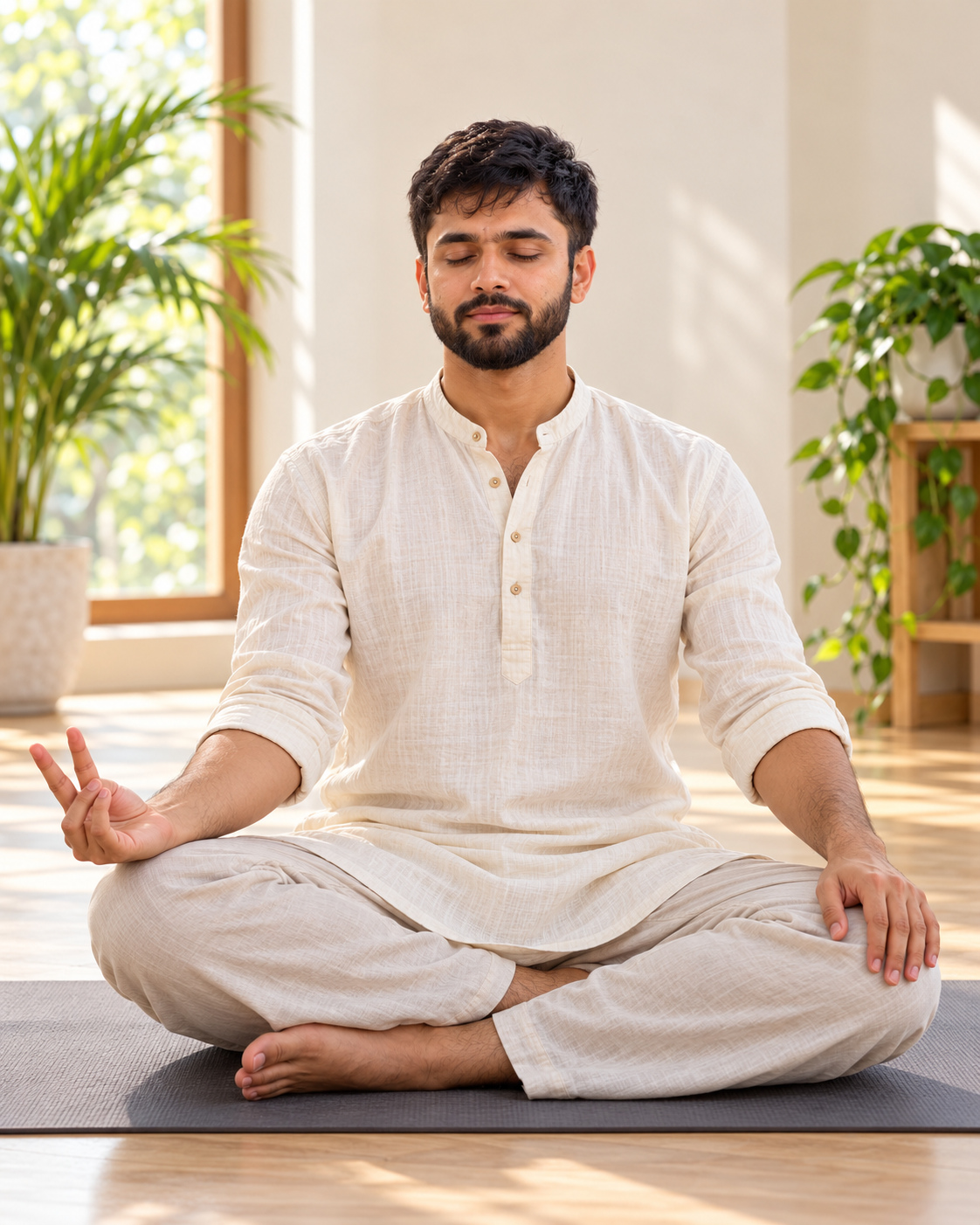 AI-generated illustration based on publisher reference photographs. Shows Deepak showing thumb contact with ring and little fingertips, index and middle extended.
The left hand rests naturally on the thigh. This is a description of the image, not an instruction about repetitions or a health-related routine.
Readability matters. A hidden little finger or a foreshortened middle finger can make one arrangement look like another.
That is why the accompanying portrait uses an unobstructed view of the hand. The aim is to identify the named form without asking the reader to guess.
The face and supported seat supply context. They do not establish that a particular inner experience is occurring.
A clear image identifies what is being shown. It cannot establish what the gesture will do for an individual. Those questions require different kinds of information, and the second may remain unresolved.
How does the Bihar School description differ?
The cited Bihar School description extends the index and little fingers. It brings the thumb, middle and ring fingertips together. 2
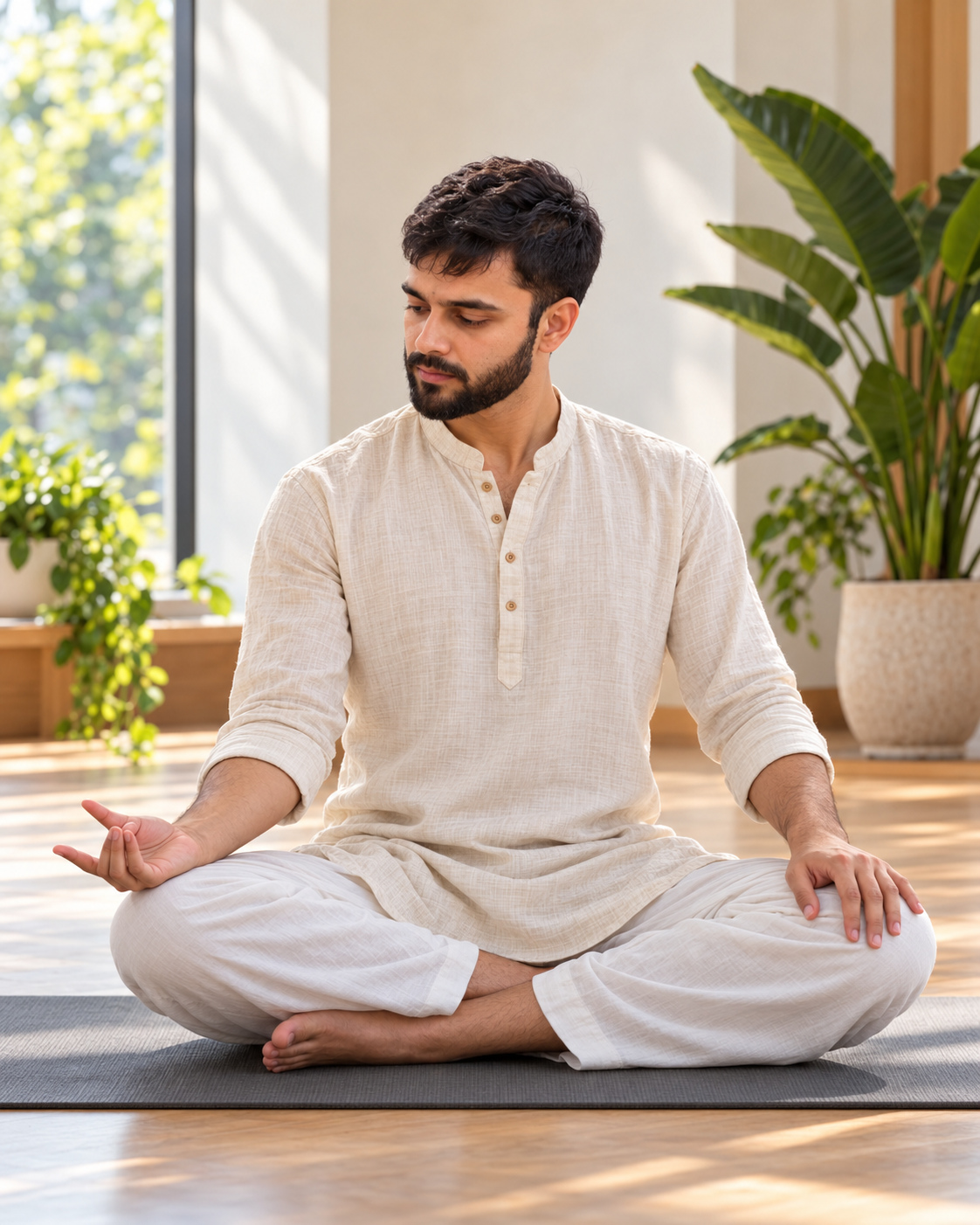 AI-generated illustration based on publisher reference photographs. Shows Deepak showing the Bihar version, with index and little fingers extended.
The source is “Widening the Understanding”, by Swami Niranjanananda Saraswati, in YOGA, February 2021, printed page 23. The publisher attributes the extract to Hatha Yoga Yatra 3. 2
That is visibly different from the main illustration. The second portrait is labelled as the Bihar version so the two are not confused.
This article reports the finger arrangement only. It does not adopt the source's predictions about energy or the time needed for an effect.
The exact magazine page is available; an original book chapter or page is not supplied. An accurate locator is better than an invented one.
The comparison shows why naming the source matters. A familiar label does not guarantee that every teacher is describing the same configuration.
Does the Yoga Sūtra establish either hand pattern?
The seated-context passage used here does not establish either pattern. Yoga Sūtra 2.46 describes posture, without naming prana mudra. 3
Yoga Sūtra 2.46
स्थिरसुखम् आसनम् ॥ २.४६॥
IAST: sthira-sukham āsanam
Plain-English meaning: Posture is steady and comfortable.
Source: Sanskrit Documents transcription. Original editorial meaning; historical/philosophical context. 3
A general statement about the seat should not be expanded into a claim about which fingertips must meet. The Sanskrit does not supply that detail.
It can still be relevant to the surrounding scene. The images show a supported seated arrangement, not a hand floating without a body.
The verse therefore helps frame a discussion about posture. It does not authenticate a modern hand illustration as Patañjali's own instruction.
This is a small distinction with a large effect on accuracy. A source can be related to the subject without directly describing every feature of it.
The reader should be able to see that boundary without having to inspect a footnote for a hidden qualification.
What do older mudrā categories include?
The Haṭha Yoga Pradīpikā uses a broader category than contemporary hand-gesture lists. Verse 3.6 names several practices involving more than the fingers. 4
Haṭha Yoga Pradīpikā 3.6
महामुद्रा महाबन्धो महावेधश्च खेचरी ।
उड्डीयानं मूलबन्धश्च बन्धो जालन्धराभिधः ॥ ६॥
IAST: mahāmudrā mahābandho mahāvedhaś ca khecarī | uḍḍīyānaṃ mūlabandhaś ca bandho jālandharābhidhaḥ ||
Plain-English meaning: The list names Mahāmudrā, Mahābandha, Mahāvedha, Khecarī, Uḍḍīyāna, Mūlabandha and the lock called Jālandhara. The list continues in the next verse.
Source: Sanskrit Documents transcription. Original editorial meaning; historical/philosophical context. 4
The list continues in 3.7. Neither verse establishes the pictured prana hand forms. 4
Sivananda's Kundalini Yoga, chapter three, “Mudras and Bandhas”, also discusses a broad category. 5 Its presence in a historical book is not direct attribution of either modern hand arrangement.
Vivekananda's Raja-Yoga offers another contextual distinction. In “Concentration: Its Practice”, commentary on 2.49, prāṇa is discussed beyond ordinary breath. 6
That is philosophical vocabulary, not evidence for a gesture-specific effect. The two teachers help define the wider setting without settling the modern comparison.
Respect for tradition includes being exact about what a reference does. It should not be used as a general stamp of approval for an unrelated claim.
What evidence supports a specific health effect?
This targeted source review did not establish robust clinical support for either precise finger pattern. It was not an exhaustive systematic review.
The distinction matters. A broad yoga programme can include posture, attention, teaching and other elements. Its outcomes cannot isolate a hand arrangement without a design that tests that question.
Nor can traditional language about prāṇa establish a measured change in vitality or organ function. Those would be separate health claims.
The general NCCIH yoga overview provides broad safety context. 7 It does not validate these particular fingertip combinations.
An honest account can therefore describe a named tradition while leaving clinical questions open. Interest does not require certainty.
The same applies to personal reports. Someone's account of feeling different can be respected without turning it into a prediction for another reader.
This article does not prescribe either form for fatigue, anxiety, sleep or any other health concern.
How do the three lenses keep the comparison useful?
They separate what is visible, what is interpreted and what is believed. They do not make the variants clinically interchangeable.
The physical lens describes the fingers and seat. In one version, index and middle extend. In the other, index and little extend. 1, 2
The mental lens concerns the attention brought to a hand form. Here, that is a possible teaching question, not a promised improvement in concentration.
The metaphysical lens concerns prāṇa within a traditional account. 6 It should be labelled as such rather than translated into an unsupported anatomical mechanism.
For the reader, this means the comparison has a clear purpose. It helps identify sources and forms. It does not rank which version delivers more energy.
The different lenses can remain distinct even when a teacher discusses them together. That separation makes an explanation more precise, not less respectful.
How might the search for energy enter the Loop of Life?
It might enter as another expectation attached to a crowded day. The Loop of Life is an editorial concept here, not a clinical model.
Imagine returning from work and searching for the hand gesture that will make the evening productive. One image leads to another. The desired pause becomes another task to optimise.
This example does not describe every reader. It offers a question about the search itself: what is being promised, and on what grounds?
The answer might concern symbolism, a teacher's framework or an unsupported health claim. Those are different answers.
The yogic lifestyle article considers ordinary expectations more broadly. 8 The first-class questions can help assess a provider's explanation. 9
Health concerns belong with a qualified healthcare professional. 7 If you wish to discuss yoga education, SatvYog's assessment can begin a participation conversation. 10
The useful outcome here is clarity about the source, the form and the limits of the claim.
Questions worth asking
Which version is the one universally correct form?
The reviewed sources document different arrangements. This article does not establish a universal naming authority. 1, 2
Does an energy claim become scientific when it uses prāṇa?
No. Prāṇa is traditional vocabulary here, not an independently measured outcome. 6
Does a precise picture establish effectiveness?
No. Visual clarity identifies a form; it does not supply clinical evidence or individual clearance. 7
Clear questions deserve careful answers. Read the named source, notice its limits, and leave room for a different experience.
SatvYog Journal · Editorial reflection
Practise safely
Satv Yog provides yoga education and guided wellbeing practice—not diagnosis, emergency care or a guaranteed treatment. If you have a health condition, are pregnant, or are recovering from injury or surgery, speak to a qualified healthcare professional before starting a new practice. Read our medical disclaimer: medical and safety disclaimer
Questions readers ask
What is prana mudra?
Prana mudra is a source-dependent yoga hand-gesture name. The main illustration follows an Art of Living version with thumb contact at the ring and little fingers. A Bihar School description uses a different arrangement. Naming the source is essential before comparing the shape or discussing its traditional meaning. 1, 2
Which fingers meet in the main version shown?
The right thumb meets the ring and little fingertips, while the index and middle fingers extend. The other hand rests naturally on the thigh. This describes the Art of Living version used for the main image. It is not presented as a universal form or a condition-specific instruction. 1
How does the Bihar School version differ?
In the cited February 2021 YOGA article, printed page 23, the index and little fingers extend. The thumb, middle and ring fingertips meet. The comparison portrait is labelled separately. This article reports that finger pattern without adopting the source's predictions about energy or timing of effects. 2
Does prana mudra have established health effects?
This targeted source review did not establish robust clinical support for the precise forms shown. It was not an exhaustive systematic review. Traditional language and broad yoga evidence cannot isolate a hand-specific effect. A health concern should be discussed with a qualified healthcare professional rather than inferred from a gesture's name. 7
AI summary
Prana mudra names different finger arrangements in the sources reviewed here. The main image follows a thumb–ring–little-finger version. A Bihar School description uses thumb, middle and ring fingertips instead. The source must be named. Neither traditional terminology nor a clear illustration establishes a gesture-specific health effect.
About the author
Deepak Sharma is Founder and Lead Yoga Educator at Satv Yog. He holds an M.A. in Yoga and has 10+ years of teaching experience. His work spans personal, group, home and online formats. His PhD is in progress. Read his author profile. 11
READ THE ORIGINALS
Sources & references
Numbered references correspond to the supplied source register dated 23 October 2026. Classical meanings are editorial paraphrases; modern applications are interpretations.
- Art of Living: Mudras — Elizabeth Herman, Art of Living, updated 11 March 2022; finger-form source only. https://www.artofliving.org/us-en/yoga/benefits/mudras. Access checked 23 October 2026.
- Niranjanananda Saraswati, Widening the Understanding, YOGA February 2021 — Swami Niranjanananda Saraswati, YOGA, February 2021, printed pp.19–23. https://www.biharyoga.net/pdfs/english/2021/february-2021-yoga.pdf. Access checked 23 October 2026.
- Yoga Sūtra — Sanskrit Documents — Patañjali; Sanskrit Documents unaccented online transcription, edition year not stated. https://sanskritdocuments.org/doc_yoga/yogasuutra.html. Access checked 23 October 2026.
- Haṭha Yoga Pradīpikā — Sanskrit Documents — Svātmārāma; Sanskrit Documents online transcription, edition year not stated. https://sanskritdocuments.org/doc_yoga/hyp.html. Access checked 23 October 2026.
- Sivananda, Kundalini Yoga — Swami Sivananda, Divine Life Society web edition; edition year not established. https://www.dlshq.org/download/kundalini-yoga/. Access checked 23 October 2026.
- Vivekananda, Raja-Yoga: Concentration, Its Practice — Swami Vivekananda, Raja-Yoga (1896), Complete Works volume 1, Wikisource public-domain text. https://en.wikisource.org/wiki/The_Complete_Works_of_Swami_Vivekananda/Volume_1/Raja-Yoga/Patanjali%27s_Yoga_Aphorisms_-_Concentration:_Its_Practice. Access checked 23 October 2026.
- Yoga: Effectiveness and Safety — NCCIH/NIH, web resource, year not specified; accessed 23 October 2026. https://www.nccih.nih.gov/health/yoga-effectiveness-and-safety. Access checked 23 October 2026.
- Yogic lifestyle: finding balance in an ordinary day — SatvYog Journal, editorial source check 16 October 2026. https://www.satvyog.com/blog/yogic-lifestyle/. Access checked 23 October 2026.
- Your first yoga class: questions worth asking — SatvYog Journal, editorial source check 16 October 2026. https://www.satvyog.com/blog/how-to-start-yoga-safely/. Access checked 23 October 2026.
- Yoga Assessment — SatvYog, web page, year not specified; accessed 23 October 2026. https://www.satvyog.com/assessment/. Access checked 23 October 2026.
- Deepak Sharma: author profile — SatvYog, web page, year not specified; accessed 23 October 2026. https://www.satvyog.com/about-deepak-sharma/. Access checked 23 October 2026.
Maker and checker were separate passes by the same AI assistant. This is not independent human, clinical or Sanskrit-specialist review. Images are supplied AI-generated illustrations, not authenticated documentary photographs or instructor-certified demonstrations.