Editorial scope: Yoga education and reflection only. No medical advice, diagnosis, treatment plan or personalised practice instructions. Independent clinical and Sanskrit-specialist review has not been performed.
In brief
Gyan mudra commonly names a thumb–index hand gesture, but Gyan and Chin labels vary between teaching sources. The version shown uses an upward-facing palm. Older posture and mudrā passages provide context without establishing this exact form. The targeted research review did not establish robust gesture-specific clinical support. 1, 2, 3, 4, 6
- Describe the fingers and name the source. 1, 2, 3
- A general classical reference is not direct origin for the pictured form. 4, 6
- Symbolic meaning is different from clinical evidence. 2
Illustrative opening
Two saved images show almost the same hand. One caption says gyan mudra; another says chin mudra. The palm direction seems to change, but the explanations do not agree. You are looking between meetings, with little patience for another confident answer that ignores the difference. This is an illustrative scene, not a student story. A useful guide begins with what can actually be seen: the fingers, the palm and the named source. It can then explain the wider tradition without attaching an unsupported health promise to a familiar shape.
What does gyan mudra mean in this article?
Gyan mudra names a thumb–index hand gesture in the version shown here. The Sanskrit form is jñāna mudrā, often translated as the gesture or seal of knowledge. 1, 2
The name does not identify one universally agreed palm orientation. Different teaching sources use Gyan and Chin labels differently. That disagreement is worth explaining rather than hiding.
For a reader arriving from an image search, the first task is simple. Identify which fingers meet and which source names the form.
Here, Deepak is seated in supported Sukhāsana, or Easy Pose. His right palm faces upward. The thumb and index fingertips meet; the other three fingers remain softly extended.
This follows the named version discussed by the Art of Living source. 1 The illustration does not establish a health effect or an inner state of knowledge.
Which fingers meet in the version shown?
The thumb and index fingertips meet. The middle, ring and little fingers remain distinct and softly extended, with the hand resting on the knee. 1
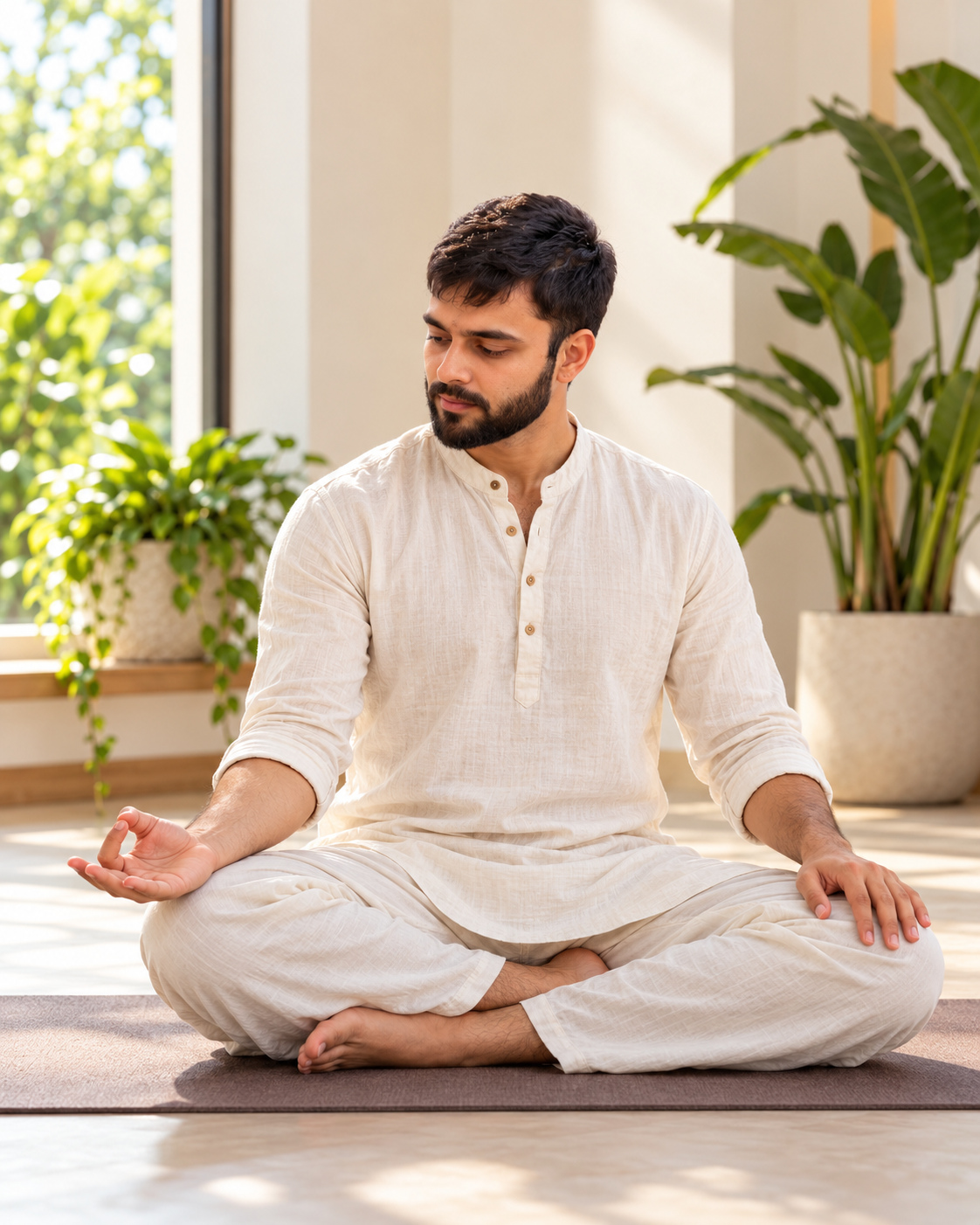 AI-generated illustration based on publisher reference photographs. Shows Deepak showing thumb–index contact with three fingers softly extended.
That describes the image, not a schedule or condition-specific recommendation. The other hand rests naturally on the thigh.
The detail matters because small visual errors change what is being shown. A curled middle finger or a hidden fingertip can make the form ambiguous.
It is also important not to confuse a finger arrangement with the whole seated position. A person can sit in different supported arrangements while discussing the same hand form.
The article therefore names both: Sukhāsana for the seat and the thumb–index version for the hand. It does not imply that the two together have a research-established effect.
A clear illustration should help a reader identify a convention. It should not ask them to infer an outcome from a calm expression.
Are Gyan Mudra and Chin Mudra always different?
No universal naming rule is established by the sources reviewed here. Some distinguish them by palm direction; others use the names interchangeably. 1, 2, 3
The Kriya Yogi glossary and Siddhi Yoga page do not present the distinction in identical ways. That makes a blanket statement about palm orientation unreliable.
The disagreement does not mean that every form is meaningless. It means an article should say whose terminology it is using.
The classroom question becomes, “What do you call this version?” That is more useful than insisting that every teacher uses the same label.
The same care applies when comparing photographs. A different palm direction may reflect a different convention, an imprecise caption or a different intended form.
Those possibilities should not be settled from an image alone. A good explanation supplies the source and describes the fingers before drawing a conclusion about the name.
Does the Yoga Sūtra describe this finger gesture?
The passage used here does not name it. Yoga Sūtra 2.46 concerns āsana, or posture, and supplies seated context only. 4
Yoga Sūtra 2.46
स्थिरसुखम् आसनम् ॥ २.४६॥
IAST: sthira-sukham āsanam
Plain-English meaning: Posture is steady and comfortable.
Source: Sanskrit Documents transcription. Original editorial meaning; historical/philosophical context. 4
The verse is concise. Adding a specific finger arrangement to its meaning would create an attribution the Sanskrit does not support.
Vivekananda comments on it in Raja-Yoga, “Concentration: Its Practice”, commentary on 2.46. 5 His discussion concerns the seat, not evidence of a gesture-specific health outcome.
That is still a relevant contribution. A hand form is not the only thing present when someone sits for yoga. The position and the demands of participation deserve attention too.
But relevance is different from direct origin. The article uses the verse to explain the seated setting. It does not claim Patañjali prescribed the pictured hand shape.
Keeping that boundary visible is part of respecting the text.
What does mudrā mean in older Hatha texts?
In the Haṭha Yoga Pradīpikā, the category includes practices far beyond small hand gestures. Verse 3.6 lists several such names. 6
Haṭha Yoga Pradīpikā 3.6
महामुद्रा महाबन्धो महावेधश्च खेचरी ।
उड्डीयानं मूलबन्धश्च बन्धो जालन्धराभिधः ॥ ६॥
IAST: mahāmudrā mahābandho mahāvedhaś ca khecarī | uḍḍīyānaṃ mūlabandhaś ca bandho jālandharābhidhaḥ ||
Plain-English meaning: The list names Mahāmudrā, Mahābandha, Mahāvedha, Khecarī, Uḍḍīyāna, Mūlabandha and the lock called Jālandhara. The list continues in the next verse.
Source: Sanskrit Documents transcription. Original editorial meaning; historical/philosophical context. 6
Read with 3.7, this is part of a list of ten mudras. It does not list the illustrated Gyan hand gesture. 6
The distinction matters because an attractive modern hand image can make the older category look much narrower than it is.
Sivananda's Kundalini Yoga, chapter three, “Mudras and Bandhas”, also covers a broader category. 7 This is historical context, not a direct source for every contemporary finger arrangement.
The two references help explain a word's range. They do not provide a shortcut from an old category to a modern health promise.
A reader can therefore ask two separate questions. What does this teacher mean by hand mudrā? What does a particular older text include under the same wider word?
What evidence supports a gesture-specific benefit?
This targeted source review did not establish robust clinical support for the exact thumb–index gesture. It was not an exhaustive review of all possible research.
That distinction avoids two kinds of overstatement. A broad yoga study does not isolate the effect of finger contact. An unsuccessful targeted search does not prove that no relevant research exists.
Any future study would need to define the hand form and the comparison clearly. It would also need to distinguish the gesture from accompanying posture, attention and teaching.
Until then, claims about memory, hormones or particular organs would need evidence beyond the name of the gesture. This article makes none of those claims.
The general NCCIH yoga overview offers broad safety context, not hand-specific validation. 8
A person may find symbolism meaningful without turning that meaning into a clinical assertion. The value of a symbol and the evidence for a health outcome are different questions.
How can the three lenses clarify the symbolism?
They separate a visible hand form, an attention-related interpretation and a philosophical reading. These are different kinds of statement.
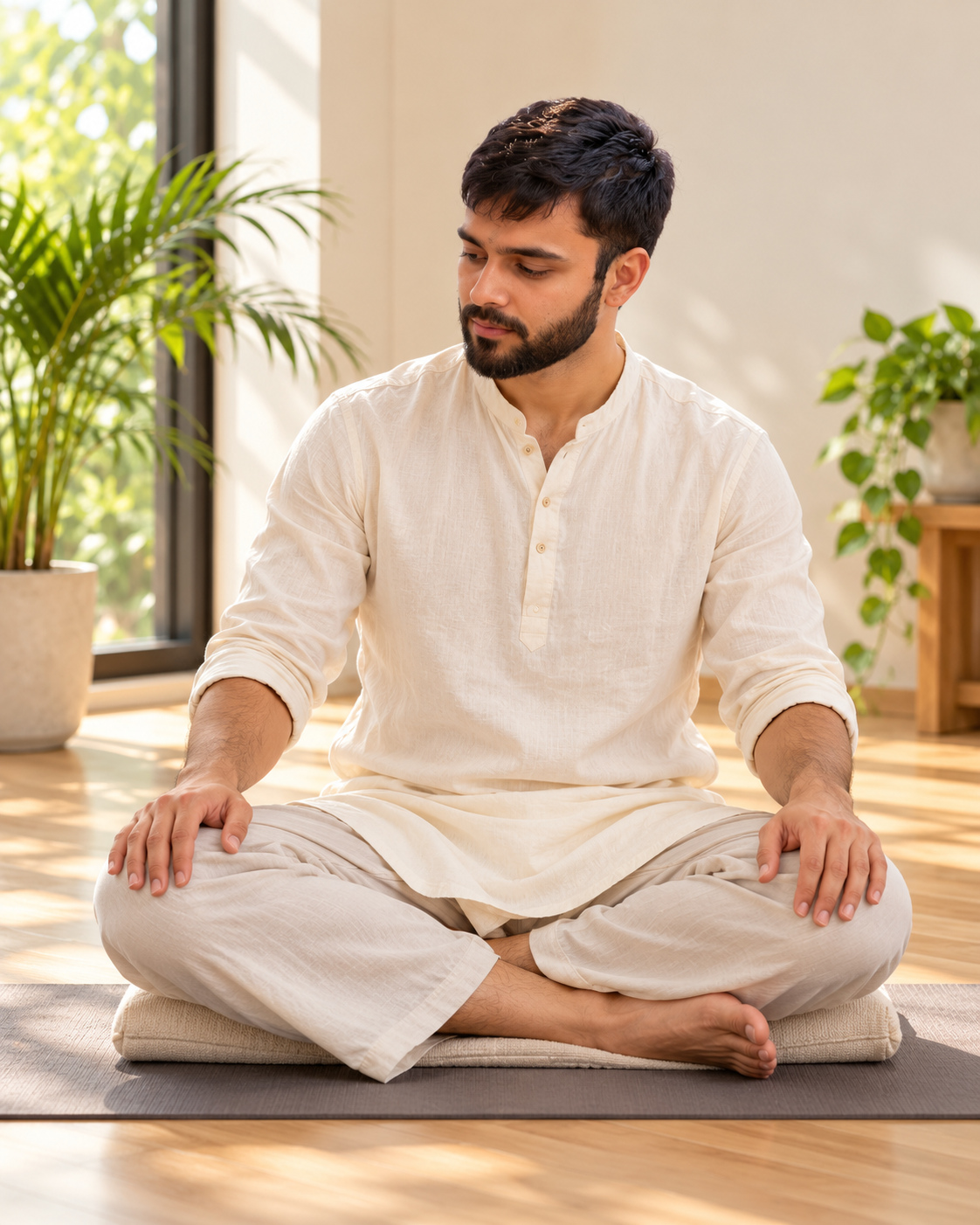 AI-generated illustration based on publisher reference photographs. Shows Deepak seated in Easy Pose with both hands resting naturally.
The physical lens describes what can be seen: contact between two fingertips, three other fingers extended, and a supported seated position.
The mental lens asks what someone attends to while using a gesture. Here, that remains a possible teaching question rather than a promised change in concentration.
The metaphysical lens concerns knowledge, identity or awareness within a named interpretation. The Kriya Yogi glossary presents such symbolism. 2 Symbolic meaning is not a measured electrical circuit.
For a working reader, this may be the useful distinction. A hand form can carry an idea without acting as a health device.
The relaxed-hands illustration makes the point from another direction. It shows the same seated context without a formal gesture. A teacher's claims should make clear what, specifically, is attributed to the hand position.
Where can a hand gesture enter the Loop of Life?
It can enter as a question about expectations. The Loop of Life is an editorial concept, not a validated account of how finger positions affect the mind.
Imagine collecting screenshots of different hand forms between work messages. Each one seems to promise a better version of the next hour. The search itself becomes another demand for optimisation.
This article invites a smaller question: what does the form mean in the source I am reading? That question can be answered without an outcome promise.
The yogic lifestyle article considers ordinary expectations more broadly. 9 The first-class questions help examine a provider's claims. 10
Health concerns belong with a qualified healthcare professional. 8 A hand diagram is not individual clearance.
If you wish to discuss learning, SatvYog's assessment can begin that conversation. 11 The aim is a clearly named practice, with its limits intact.
Questions worth asking
Does one palm direction settle the name everywhere?
No universal rule was established by the reviewed sources. Their conventions differ. 1, 2, 3
Did Patañjali describe these fingers?
The cited posture verse does not name the hand arrangement. It supplies context only. 4
Can symbolism be meaningful without a health promise?
Yes, as a philosophical or teaching interpretation. That meaning is different from evidence of a clinical outcome. 2
Clear questions deserve careful answers. Read the named source, notice its limits, and leave room for a different experience.
SatvYog Journal · Editorial reflection
Practise safely
Satv Yog provides yoga education and guided wellbeing practice—not diagnosis, emergency care or a guaranteed treatment. If you have a health condition, are pregnant, or are recovering from injury or surgery, speak to a qualified healthcare professional before starting a new practice. Read our medical disclaimer: medical and safety disclaimer
Questions readers ask
What is gyan mudra?
Gyan mudra commonly names a thumb–index gesture associated with knowledge in yoga teaching. In the version shown, the palm faces upward and three fingers remain softly extended. The name and orientation are source-labelled because reviewed teaching pages do not establish a single universal Gyan/Chin naming rule. 1, 2, 3
What is the difference between Gyan Mudra and Chin Mudra?
Sources vary. Some distinguish the names through palm orientation, while others use them interchangeably. The reviewed pages do not support imposing one rule on every tradition. Describe which fingertips meet, identify the palm direction and ask which source or teaching convention a provider is following. 1, 2, 3
Does the Yoga Sūtra describe the thumb–index gesture?
The passage cited here, Yoga Sūtra 2.46, concerns posture. It does not name this finger arrangement. The Haṭha Yoga Pradīpikā mudrā list also has a broader scope than modern hand-gesture lists. These references supply context, not direct attribution or gesture-specific clinical validation. 4, 6
Are health benefits established for this exact gesture?
The targeted review for this article did not establish robust clinical support for the exact form shown. It was not an exhaustive systematic review. Broad yoga evidence cannot isolate fingertip contact without an appropriate study design. Health concerns should be discussed with a qualified healthcare professional. 8
AI summary
Gyan mudra commonly names a thumb–index hand gesture, but Gyan and Chin labels vary between teaching sources. The version shown uses an upward-facing palm. Older posture and mudrā passages provide context without establishing this exact form. The targeted research review did not establish robust gesture-specific clinical support.
About the author
Deepak Sharma is Founder and Lead Yoga Educator at Satv Yog. He holds an M.A. in Yoga and has 10+ years of teaching experience. His work spans personal, group, home and online formats. His PhD is in progress. Read his author profile. 12
READ THE ORIGINALS
Sources & references
Numbered references correspond to the supplied source register dated 23 October 2026. Classical meanings are editorial paraphrases; modern applications are interpretations.
- Art of Living: Mudras — Elizabeth Herman, Art of Living, updated 11 March 2022; finger-form source only. https://www.artofliving.org/us-en/yoga/benefits/mudras. Access checked 23 October 2026.
- The Kriya Yogi: Gyan Mudra — The Kriya Yogi, updated 27 September 2026; nomenclature source only. https://thekriyayogi.com/resources/glossary/gyan-mudra. Access checked 23 October 2026.
- Siddhi Yoga: Chin Mudra — Siddhi Yoga, web page; year not established; nomenclature source only. https://www.siddhiyoga.com/yoga/practice/mudra/chin-mudra. Access checked 23 October 2026.
- Yoga Sūtra — Sanskrit Documents — Patañjali; Sanskrit Documents unaccented online transcription, edition year not stated. https://sanskritdocuments.org/doc_yoga/yogasuutra.html. Access checked 23 October 2026.
- Vivekananda, Raja-Yoga: Concentration, Its Practice — Swami Vivekananda, Raja-Yoga (1896), Complete Works volume 1, Wikisource public-domain text. https://en.wikisource.org/wiki/The_Complete_Works_of_Swami_Vivekananda/Volume_1/Raja-Yoga/Patanjali%27s_Yoga_Aphorisms_-_Concentration:_Its_Practice. Access checked 23 October 2026.
- Haṭha Yoga Pradīpikā — Sanskrit Documents — Svātmārāma; Sanskrit Documents online transcription, edition year not stated. https://sanskritdocuments.org/doc_yoga/hyp.html. Access checked 23 October 2026.
- Sivananda, Kundalini Yoga — Swami Sivananda, Divine Life Society web edition; edition year not established. https://www.dlshq.org/download/kundalini-yoga/. Access checked 23 October 2026.
- Yoga: Effectiveness and Safety — NCCIH/NIH, web resource, year not specified; accessed 23 October 2026. https://www.nccih.nih.gov/health/yoga-effectiveness-and-safety. Access checked 23 October 2026.
- Yogic lifestyle: finding balance in an ordinary day — SatvYog Journal, editorial source check 16 October 2026. https://www.satvyog.com/blog/yogic-lifestyle/. Access checked 23 October 2026.
- Your first yoga class: questions worth asking — SatvYog Journal, editorial source check 16 October 2026. https://www.satvyog.com/blog/how-to-start-yoga-safely/. Access checked 23 October 2026.
- Yoga Assessment — SatvYog, web page, year not specified; accessed 23 October 2026. https://www.satvyog.com/assessment/. Access checked 23 October 2026.
- Deepak Sharma: author profile — SatvYog, web page, year not specified; accessed 23 October 2026. https://www.satvyog.com/about-deepak-sharma/. Access checked 23 October 2026.
Maker and checker were separate passes by the same AI assistant. This is not independent human, clinical or Sanskrit-specialist review. Images are supplied AI-generated illustrations, not authenticated documentary photographs or instructor-certified demonstrations.