Editorial scope: Yoga education and reflection only. No medical advice, diagnosis, treatment plan or personalised practice instructions. Independent clinical and Sanskrit-specialist review has not been performed.
In brief
A mudra for anxiety article can describe a named hand gesture without presenting it as established mental-health care. The exact thumb–index form shown lacks robust clinical support in this targeted review. Classical passages provide philosophical context, and broad yoga trials do not isolate a finger-specific effect. 1, 2, 5, 6
- A finger-form source is not evidence of an anxiety outcome. 1
- A whole-programme trial cannot validate one isolated hand gesture. 5, 6
- The cited Sanskrit passages do not name the illustrated form. 2
Illustrative opening
An unanswered message has become the centre of the evening. You find a page labelled mudra for anxiety and look at the small circle made by thumb and finger. The gesture seems simple. The promise beside it is much larger. This is an illustrative scene, not a participant's account. A useful answer should respect the question without accepting the promise automatically. What is the hand actually showing? What do the older texts discuss? And where does a familiar yoga symbol stop short of evidence for a mental-health claim?
What can a mudra for anxiety article responsibly say?
A hand mudrā can be described as a named yoga gesture. It should not be presented as an established intervention for an anxiety disorder.
The targeted source review for this article did not establish robust clinical support for the exact gesture shown. That is a limited search conclusion, not proof that no relevant research exists.
The distinction matters because the search phrase already suggests an outcome. A page can answer the phrase without accepting its implied promise.
Here, the pictured form is a thumb–index hand gesture. The source describes its fingers; it does not provide adequate evidence for an anxiety claim. 1
A reader may still be curious about its meaning. That curiosity deserves a clear answer rather than a list of unsupported benefits.
The article therefore explains the form, the older context and the difference between a symbol and evidence for a health outcome.
Which hand gesture does the image show?
The left thumb and index fingertips meet. The middle, ring and little fingers remain softly extended, with the palm upward. 1
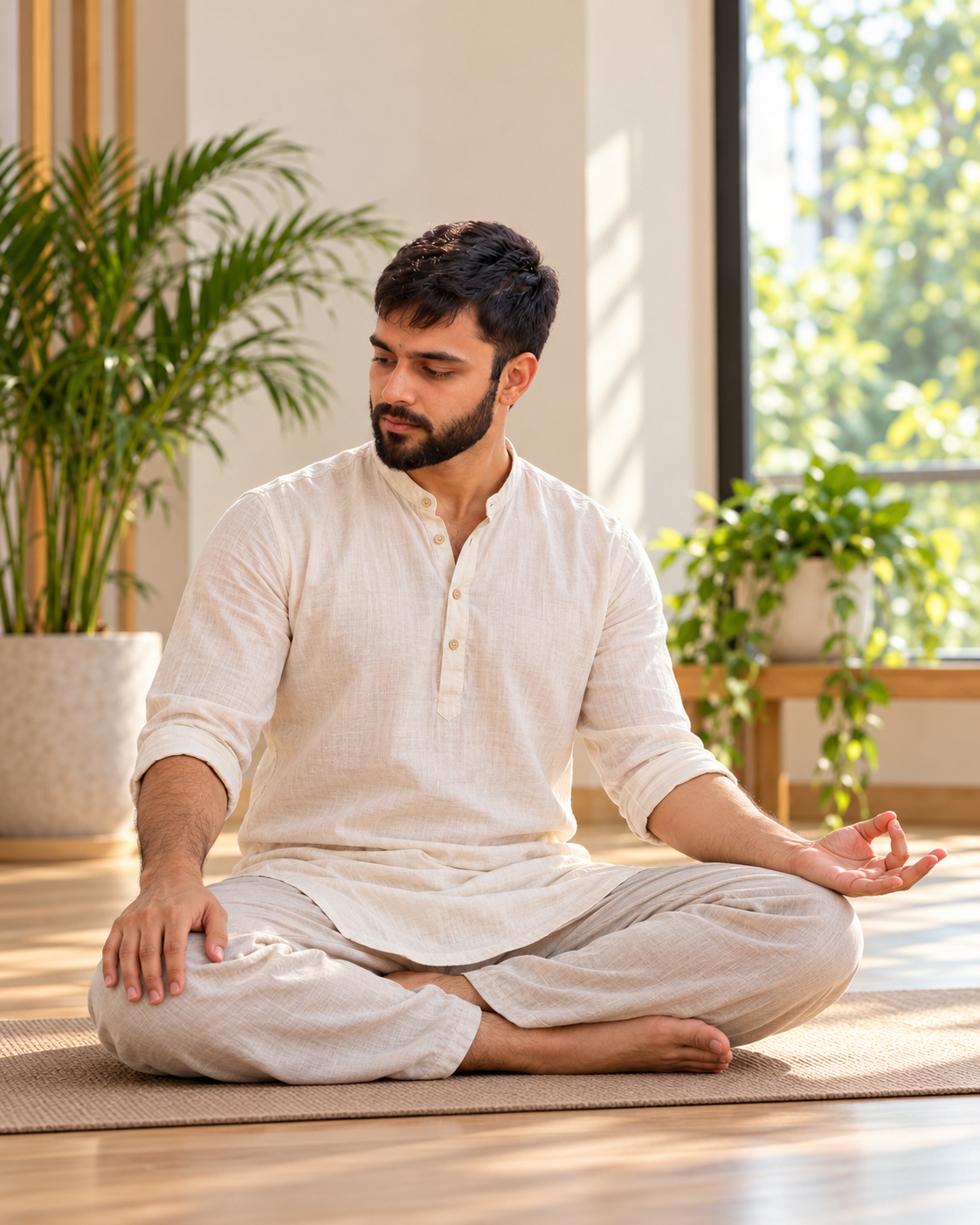 AI-generated illustration based on publisher reference photographs. Shows Deepak showing a left thumb–index gesture with three fingers extended.
Deepak sits in supported Sukhāsana, or Easy Pose. His right hand rests naturally on the thigh.
This follows a named thumb–index version. The image does not imply that a single label or palm orientation is universal across all teaching traditions.
It also does not show someone receiving mental-health care. A photograph-like illustration cannot establish a diagnosis, an internal state or a health outcome.
The second seated illustration leaves both hands resting naturally. It supports a discussion about choice rather than presenting two competing anxiety methods.
This makes the article's claim concrete. We can identify which fingers meet. We cannot infer from that contact that a clinical process has been changed.
The difference is central to the subject, not a qualification added at the end.
Do Patañjali's passages validate the hand position?
No. The passages used here discuss practice, non-attachment and attitudes of mind. Neither names the illustrated finger arrangement. 2
Yoga Sūtra 1.12
अभ्यासवैराग्याभ्यां तन्निरोधः ॥ १.१२॥
IAST: abhyāsa-vairāgyābhyāṃ tan-nirodhaḥ
Plain-English meaning: Their restraint comes through practice and non-attachment. Here, ‘their’ refers to the movements of mind discussed earlier.
Source: Sanskrit Documents transcription. Original editorial meaning; historical/philosophical context. 2
Abhyāsa means practice; vairāgya concerns non-attachment or dispassion. Their philosophical relationship should not be rewritten as a claim about fingertip contact.
A second passage concerns attitudes towards different human situations. 2
Yoga Sūtra 1.33
मैत्रीकरुणामुदितोपेक्षाणां सुखदुःखपुण्यापुण्यविषयाणां भावनातश्चित्तप्रसादनम् ॥ १.३३॥
IAST: maitrī-karuṇā-muditopekṣāṇāṃ sukha-duḥkha-puṇyāpuṇya-viṣayāṇāṃ bhāvanātaś citta-prasādanam
Plain-English meaning: Cultivating friendliness, compassion, gladness and equanimity towards happiness, suffering, virtue and non-virtue brings clarity to the mind.
Source: Sanskrit Documents transcription. Original editorial meaning; historical/philosophical context. 2
It discusses friendliness, compassion, gladness and equanimity. It does not establish a hand-specific effect on anxiety.
An editorial reflection might ask whether every unsettled moment needs an immediate technique. That is a question inspired by the discussion, not the plain meaning of the Sanskrit.
The distinction allows the passages to remain meaningful on their own terms. They do not need to become clinical evidence to deserve attention.
It also avoids blaming someone whose anxiety persists. The verses should not be used to measure another person's spiritual effort.
What do the teachers contribute without proving a health claim?
They contribute interpretations and historical context. Vivekananda discusses Yoga Sūtra 1.33 in Raja-Yoga, “Concentration: Its Spiritual Uses”. 3
Sivananda's Kundalini Yoga, chapter three, “Mudras and Bandhas”, discusses a broad practice category. 4 It does not directly validate this finger gesture for anxiety.
That difference between context and proof matters. A teacher's name can make a claim feel settled even when the cited passage does not address it.
The same care applies to the word mudrā. In older Hatha discussions, the category extends beyond small hand configurations. 4 A modern hand image should not stand for the whole historical field.
A reader can therefore ask what a citation is doing. Is it identifying a source, explaining a meaning or supporting a measured outcome?
Those are legitimate questions in a yoga class as well as in an article. Respectful enquiry does not require automatic agreement.
Can a broad yoga trial establish a finger-specific benefit?
No. A whole-programme trial cannot isolate the effect of one hand position unless its design tests that component.
The JAMA Psychiatry anxiety trial compared a Kundalini programme with cognitive behavioural therapy and stress education. 5 NCCIH's report describes multiple programme elements. 6
That is a different question from whether touching the thumb and index finger changes anxiety. The trial does not establish such a hand-specific effect.
The distinction also applies to a calm-looking participant. A picture can show posture and fingers. It cannot supply the missing comparison group.
This article therefore makes no statement about a gesture balancing hormones, completing a nerve circuit or changing an anxiety score. Those claims would need appropriate evidence.
The limit does not prevent cultural or philosophical explanation. It simply keeps that explanation separate from clinical validation.
Someone can find a symbol meaningful without being promised a measurable health result from its shape.
Could a gesture be an optional attention cue?
It can be discussed as an optional cue within a named teaching approach. That proposal is not the same as an established anxiety intervention.
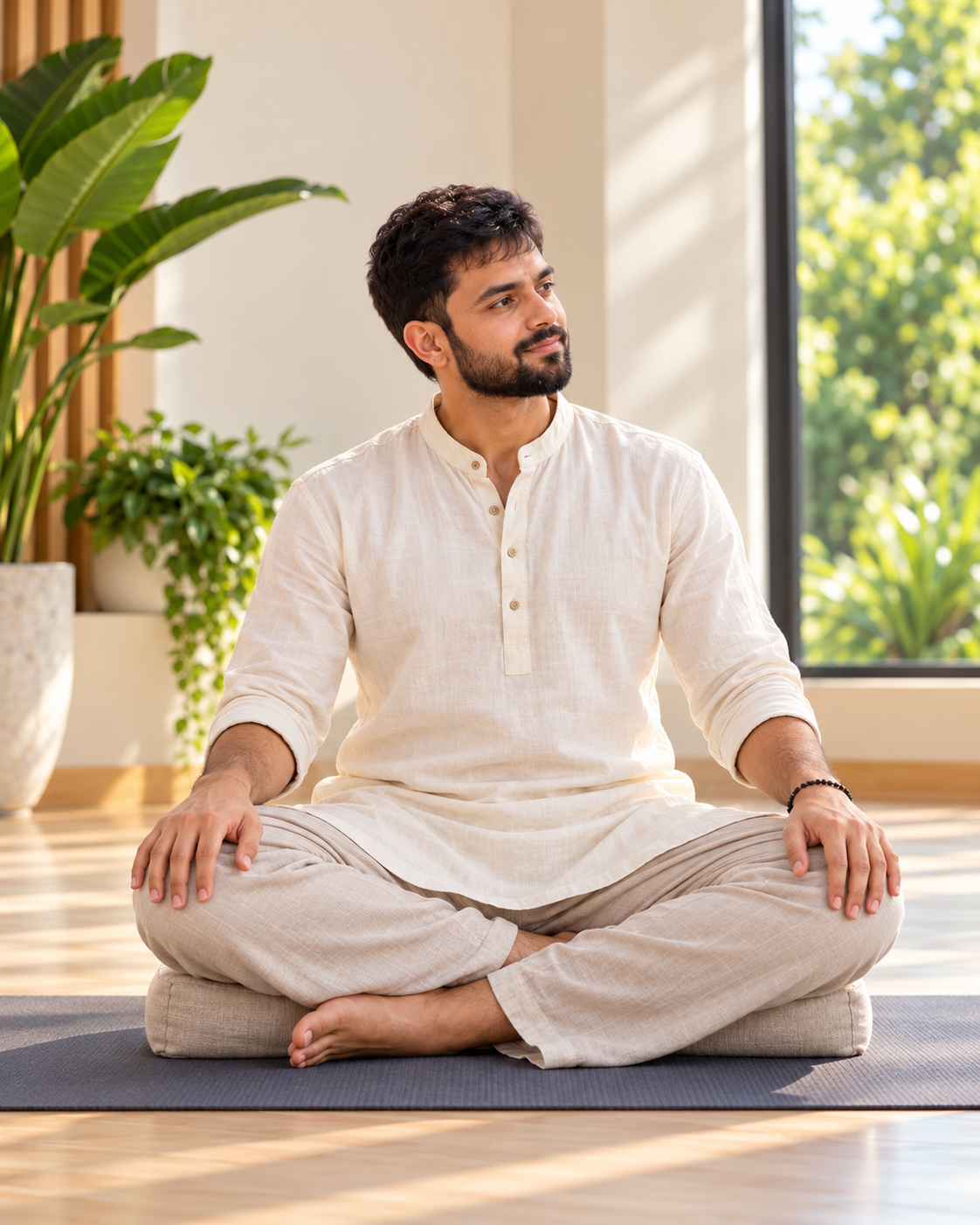 AI-generated illustration based on publisher reference photographs. Shows Deepak seated with open eyes and both hands resting on his thighs.
An attention cue is something a teacher might use to frame a learning task. This article does not claim that the pictured hand form improves attention or suits every participant.
The option to leave the hands resting is equally visible. The article does not make acceptance of a gesture a test of commitment.
For a reader, this makes the class question more precise. What is the teacher asking the gesture to represent? What happens if the participant prefers not to use it?
A clear answer should not depend on a health promise. It can concern symbolism, terminology or the teacher's particular framework.
If discomfort or a health concern is involved, a qualified healthcare professional should advise on that concern. 7 The hand illustration is not individual clearance.
What do the three lenses add to a restless working day?
They keep the hand form, the interpretation and the philosophical setting distinct. None makes a restless mind a diagnosis.
The physical lens describes the seat and fingers. The mental lens concerns the expectations someone brings to the gesture. The metaphysical lens concerns the meaning assigned within a tradition.
Imagine reading a difficult message, searching for a calming technique and then checking whether it has worked. The sequence could become another demand for an immediate result.
This is one illustrative version of the Loop of Life. The term is an editorial concept, not an established explanation of anxiety.
The question might be whether the search itself has become a performance task. It does not follow that noticing this will change a health condition.
The yogic lifestyle article explores ordinary expectations more broadly. 8 This article focuses on keeping a hand-specific claim within its evidence.
Where do assessment and support belong?
Concerns about an anxiety disorder belong with a qualified doctor or mental-health professional. A yoga teacher can explain practice, participation and limits. 9
A yoga class should not be described as a substitute for established care. Nor should a person be told that continuing anxiety reflects a failure to practise sincerely.
The first-class questions article can help frame questions about a provider. 10 Those questions concern the offering, not self-diagnosis.
SatvYog's assessment is a participation conversation. 11 It is not an anxiety assessment.
If you are struggling, you can call Tele-MANAS, India’s free 24x7 mental health helpline, on 14416. 12, 13
A responsible answer can leave the reader with a clear description and an honest limit. A familiar gesture does not need an unfamiliar medical promise attached to it.
Questions worth asking
Is a simple gesture harmless enough to promise a benefit?
Simplicity is not evidence of effectiveness or individual suitability. A claim still needs appropriate support. 7
Does a full yoga programme validate a hand gesture?
No. Its findings cannot isolate a component that was not separately tested. 5, 6
Does continuing anxiety mean poor practice?
This article makes no such judgement. A health concern deserves qualified assessment and support. 9
Clear questions deserve careful answers. Read the named source, notice its limits, and leave room for a different experience.
SatvYog Journal · Editorial reflection
Practise safely
Satv Yog provides yoga education and guided wellbeing practice—not diagnosis, emergency care or a guaranteed treatment. If you have a health condition, are pregnant, or are recovering from injury or surgery, speak to a qualified healthcare professional before starting a new practice. Read our medical disclaimer: medical and safety disclaimer
Questions readers ask
Is a mudra an established intervention for anxiety?
The targeted source review for this article did not establish robust clinical support for the exact gesture shown. That is not an exhaustive review or a claim that no research exists. A named hand form can be explained without presenting it as a substitute for qualified mental-health care. 9
Which mudra is illustrated here?
The image shows a left thumb–index gesture with the palm upward and three other fingers softly extended. Deepak sits in supported Easy Pose. The source identifies the finger arrangement, not a clinical effect. A second image shows resting hands to support the discussion of choice. 1
Can a gesture be an attention cue?
A teacher may discuss a gesture as an optional cue within a named approach. That proposal does not establish an improvement in attention or an anxiety outcome. Ask what the gesture represents and what choices remain. The article offers no condition-specific routine or requirement to use the form.
Can hand mudras replace professional support?
This article does not support substituting a hand gesture for mental-health assessment or established care. Broad yoga findings do not isolate finger-specific effects. Discuss an anxiety concern with a qualified doctor or mental-health professional; a yoga teacher can explain participation and the limits of the class. 9, 5, 6
AI summary
A mudra for anxiety article can describe a named hand gesture without presenting it as established mental-health care. The exact thumb–index form shown lacks robust clinical support in this targeted review. Classical passages provide philosophical context, and broad yoga trials do not isolate a finger-specific effect.
About the author
Deepak Sharma is Founder and Lead Yoga Educator at Satv Yog. He holds an M.A. in Yoga and has 10+ years of teaching experience. His work spans personal, group, home and online formats. His PhD is in progress. Read his author profile. 14
READ THE ORIGINALS
Sources & references
Numbered references correspond to the supplied source register dated 23 October 2026. Classical meanings are editorial paraphrases; modern applications are interpretations.
- Art of Living: Mudras — Elizabeth Herman, Art of Living, updated 11 March 2022; finger-form source only. https://www.artofliving.org/us-en/yoga/benefits/mudras. Access checked 23 October 2026.
- Yoga Sūtra — Sanskrit Documents — Patañjali; Sanskrit Documents unaccented online transcription, edition year not stated. https://sanskritdocuments.org/doc_yoga/yogasuutra.html. Access checked 23 October 2026.
- Vivekananda, Raja-Yoga: Concentration, Its Spiritual Uses — Swami Vivekananda, Raja-Yoga (1896), Complete Works volume 1, Wikisource public-domain text. https://en.wikisource.org/wiki/The_Complete_Works_of_Swami_Vivekananda/Volume_1/Raja-Yoga/Patanjali%27s_Yoga_Aphorisms_-_Concentration:_Its_Spiritual_Uses. Access checked 23 October 2026.
- Sivananda, Kundalini Yoga — Swami Sivananda, Divine Life Society web edition; edition year not established. https://www.dlshq.org/download/kundalini-yoga/. Access checked 23 October 2026.
- Efficacy of Yoga vs Cognitive Behavioral Therapy vs Stress Education for the Treatment of Generalized Anxiety Disorder — Simon, Hofmann, Rosenfield et al.; JAMA Psychiatry 2021;78(1):13–20; online 2020. https://jamanetwork.com/journals/jamapsychiatry/fullarticle/2769486. Access checked 23 October 2026.
- Kundalini Yoga Is Helpful for Adults With Generalized Anxiety Disorder but not as Effective as Cognitive Behavioral Therapy — NCCIH/NIH, 12 August 2020. https://www.nccih.nih.gov/research/research-results/kundalini-yoga-is-helpful-for-adults-with-generalized-anxiety-disorder-but-not-as-effective-as-cognitive-behavioral-therapy. Access checked 23 October 2026.
- Yoga: Effectiveness and Safety — NCCIH/NIH, web resource, year not specified; accessed 23 October 2026. https://www.nccih.nih.gov/health/yoga-effectiveness-and-safety. Access checked 23 October 2026.
- Yogic lifestyle: finding balance in an ordinary day — SatvYog Journal, editorial source check 16 October 2026. https://www.satvyog.com/blog/yogic-lifestyle/. Access checked 23 October 2026.
- Anxiety and Complementary Health Approaches — NCCIH/NIH, web resource, year not specified; accessed 23 October 2026. https://www.nccih.nih.gov/health/anxiety-and-complementary-health-approaches. Access checked 23 October 2026.
- Your first yoga class: questions worth asking — SatvYog Journal, editorial source check 16 October 2026. https://www.satvyog.com/blog/how-to-start-yoga-safely/. Access checked 23 October 2026.
- Yoga Assessment — SatvYog, web page, year not specified; accessed 23 October 2026. https://www.satvyog.com/assessment/. Access checked 23 October 2026.
- Steps Taken to Strengthen and Integrate Mental Healthcare Services — Ministry of Health and Family Welfare / PIB, 27 March 2026. https://www.pib.gov.in/PressReleasePage.aspx?PRID=2245967&lang=1®=3. Access checked 23 October 2026.
- Over 200,000 calls received on the Tele-MANAS Helpline — Ministry of Health and Family Welfare / PIB, 22 July 2023. https://www.pib.gov.in/PressReleaseIframePage.aspx?PRID=1941620®=48&lang=2. Access checked 23 October 2026.
- Deepak Sharma: author profile — SatvYog, web page, year not specified; accessed 23 October 2026. https://www.satvyog.com/about-deepak-sharma/. Access checked 23 October 2026.
Maker and checker were separate passes by the same AI assistant. This is not independent human, clinical or Sanskrit-specialist review. Images are supplied AI-generated illustrations, not authenticated documentary photographs or instructor-certified demonstrations.